
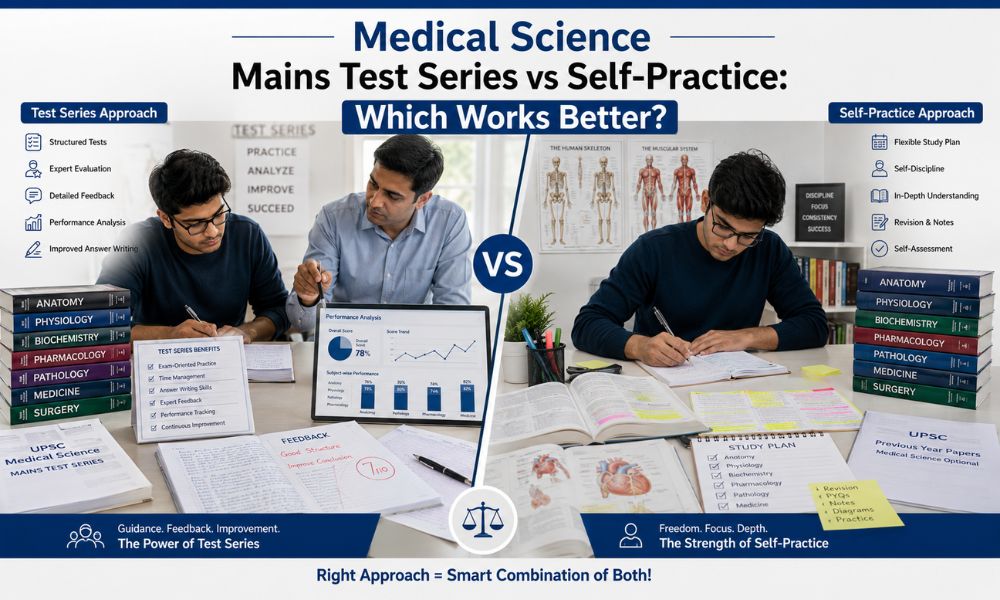
Preparing for the UPSC Civil Services Examination is a demanding journey, especially when it comes to optional subjects. For candidates choosing Medical Science, the challenge is not just understanding concepts but also presenting them effectively in the Mains examination. As preparation progresses, many aspirants wonder whether a Medical Science Mains Test Series is necessary or if self-practice alone can deliver the desired results.?
The debate between test series and self-practice has existed for years, and both approaches have their advantages. Some aspirants believe that consistent self-study and answer writing are sufficient, while others feel that structured evaluation through a test series is essential for success.
The truth lies somewhere in between. To determine which method works better, it is important to understand what each approach offers and how it contributes to overall preparation.
Understanding the Purpose of Self-Practice
Self-practice is often the foundation of UPSC preparation. It allows aspirants to study independently, revise concepts, and develop their own understanding of the syllabus.
For Medical Science Optional, self-practice can include:
- Reading standard textbooks
- Revising notes
- Solving previous year questions
- Writing answers regularly
- Preparing diagrams and flowcharts
- Creating revision summaries
One of the biggest advantages of self-practice is flexibility. Students can focus on topics they find difficult and spend more time strengthening weak areas.
Since Medical Science is already familiar to most medical graduates, self-practice helps them reconnect with concepts they have studied during their academic years.
Benefits of Self-Practice
Complete Control Over Learning
When studying independently, aspirants decide what to study, when to study, and how much time to spend on each topic.
This freedom allows personalized preparation based on individual strengths and weaknesses.
Better Conceptual Understanding
Self-study encourages active learning.
Instead of depending on external guidance for every topic, aspirants engage deeply with concepts and develop stronger understanding.
Cost-Effective Preparation
Self-practice requires minimal financial investment. With the right books, notes, and previous year papers, students can cover a significant portion of the syllabus independently.
Strong Revision Habits
Repeated self-study naturally improves retention and recall.
Medical Science contains a vast syllabus, and revision plays a major role in scoring well. Self-practice often creates disciplined revision routines.
Limitations of Self-Practice
While self-practice has several advantages, it also comes with certain challenges.
Lack of Feedback
Perhaps the biggest drawback is the absence of expert evaluation.
You may write multiple answers, but without feedback, it becomes difficult to know whether your approach is correct.
Difficulty Identifying Mistakes
Students often repeat the same errors unknowingly.
Common issues include:
- Poor answer structure
- Excessive detail
- Missing keywords
- Weak introductions and conclusions
- Ineffective diagram usage
Without guidance, these mistakes may continue until the actual examination.
No Benchmarking
When preparing alone, aspirants cannot easily compare their performance with others.
As a result, they may overestimate or underestimate their preparation level.
What is a Medical Science Mains Test Series?
A Medical Science Mains Test Series is designed to simulate the actual UPSC examination environment.
It typically includes:
- Topic-wise tests
- Full-length mock tests
- Answer evaluation
- Expert feedback
- Model answers
- Performance analysis
The objective is not only to test knowledge but also to improve answer-writing skills and examination readiness.
Benefits of a Medical Science Mains Test Series
Real Examination Experience
One major advantage of test series is exposure to exam-like conditions.
Writing answers within a fixed time frame helps improve speed and accuracy.
This experience becomes extremely valuable during the actual examination.
Professional Evaluation
A good evaluator can identify issues that students often overlook.
Feedback may highlight:
- Presentation weaknesses
- Content gaps
- Diagram quality
- Structure problems
- Time management concerns
These insights help aspirants improve continuously.
Improved Answer Writing
Many candidates possess excellent medical knowledge but fail to convert it into high-scoring answers.
Regular testing teaches students how to:
- Present information effectively
- Prioritize important points
- Use diagrams strategically
- Write concise and relevant answers
These skills can significantly influence final scores.
Performance Tracking
A test series provides measurable progress.
Students can monitor improvement over time and identify areas that require additional attention.
This data-driven approach often makes preparation more focused and efficient.
Limitations of a Test Series
Despite its benefits, a test series is not a complete solution.
It Cannot Replace Study
Some students mistakenly believe that enrolling in a test series automatically improves performance.
However, tests are only effective when supported by thorough preparation and revision.
Dependency Risk
Over-reliance on evaluation can sometimes reduce independent thinking.
Students may begin focusing only on expected questions rather than developing comprehensive understanding.
Quality Matters
Not all test series are equally effective.
Poor-quality evaluation or unrealistic questions may provide limited value to aspirants.
Choosing the right program is therefore essential.
Which Approach Produces Better Results?
If we compare the two directly, self-practice builds knowledge while a test series improves application.
Self-practice helps you learn concepts.
A test series helps you demonstrate those concepts effectively in the examination.
Neither approach alone is sufficient for most aspirants.
For example:
A student who only practices independently may possess excellent knowledge but struggle with presentation.
On the other hand, a student who joins a test series without adequate preparation may receive repeated feedback without meaningful improvement.
The most successful candidates generally combine both methods.
The Ideal Strategy: Combining Self-Practice and Test Series
Instead of treating self-practice and test series as competing approaches, consider them complementary tools.
An effective preparation plan may look like this:
Phase 1: Concept Building
Focus on:
- Standard textbooks
- Personal notes
- Topic-wise revision
- Previous year questions
At this stage, self-practice should dominate preparation.
Phase 2: Structured Answer Writing
Begin writing answers regularly.
Practice:
- Short notes
- Previous year questions
- Diagram-based answers
- Clinical explanations
This phase bridges the gap between learning and application.
Phase 3: Test Series Integration
Once major syllabus coverage is completed, incorporate a test series.
Use feedback to:
- Improve presentation
- Refine content
- Enhance time management
- Strengthen weak topics
This stage converts preparation into examination readiness.
Why Feedback Often Makes the Difference
Many aspirants preparing independently are surprised when their actual scores do not reflect their knowledge level.
The reason is simple.
UPSC rewards effective communication, not just information.
A well-structured answer with relevant diagrams and precise content often scores higher than a lengthy answer filled with excessive detail.
This is where expert evaluation becomes particularly valuable.
Programs such as UPSCRx focus on helping Medical Science aspirants understand how to translate their medical knowledge into high-scoring UPSC answers through structured testing, mentorship, and targeted feedback.
Conclusion
So, Medical Science Mains Test Series or self-practice—which works better?
The answer is that both play important but different roles in preparation.
Self-practice develops conceptual understanding, strengthens revision, and builds confidence in the subject. A test series refines answer-writing skills, provides valuable feedback, and prepares aspirants for real examination conditions.
Rather than choosing one over the other, aspirants should aim to integrate both into their preparation strategy. Knowledge and practice create the foundation, while evaluation and feedback help maximize performance.
In the end, success in Medical Science Optional comes from a balanced approach that combines disciplined self-study with continuous improvement through testing and assessment.