
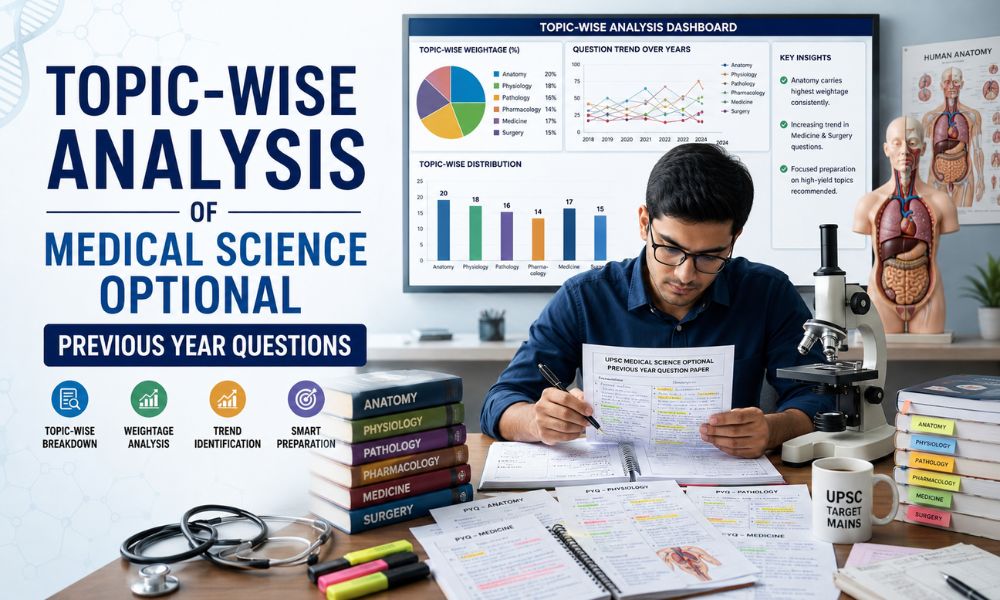
For any UPSC aspirant choosing Medical Science as an optional subject, previous year questions are one of the most valuable resources available. They not only reveal the nature of questions asked by the UPSC but also help candidates understand important topics, recurring themes, and answer-writing expectations.
Many students spend months studying standard textbooks yet struggle to convert their knowledge into marks because they fail to analyze the examination pattern. A topic-wise review of previous year questions can bridge this gap and help aspirants prepare in a more focused and strategic manner.
Why Analyze Previous Year Questions Topic-Wise?
Medical Science is a vast subject covering both pre-clinical and clinical disciplines. Without a structured approach, candidates often spend too much time on less relevant areas while neglecting high-yield topics.
A topic-wise analysis helps you:
- Identify frequently asked topics
- Understand the depth of questions
- Prioritize revision
- Improve answer-writing skills
- Recognize changing trends in the examination
Instead of treating previous year questions as a revision tool alone, aspirants should use them as a roadmap for preparation.
Understanding the Structure of Medical Science Optional
Medical Science Optional consists of two papers.
Paper I
Paper I primarily includes:
- Human Anatomy
- Human Physiology
- Biochemistry
- Pathology
- Microbiology
- Pharmacology
- Forensic Medicine
Paper II
Paper II focuses on clinical subjects such as:
- General Medicine
- Pediatrics
- Dermatology
- Psychiatry
- General Surgery
- Orthopedics
- Obstetrics and Gynecology
- Community Medicine
Analyzing questions from each subject separately provides valuable insights into topic weightage and examination trends.
Anatomy: Consistently Important
Anatomy remains one of the most reliable sections in Paper I. Questions are often direct, conceptual, and diagram-oriented.
Frequently asked areas include:
- Cranial nerves
- Blood supply of organs
- Embryology
- Histology
- Neuroanatomy
Candidates should focus on clear diagrams and concise explanations, as visual presentation often enhances answer quality.
Physiology: Conceptual Clarity Matters
Physiology contributes significantly to the paper and often includes questions that test understanding rather than memorization.
Important themes include:
- Cardiovascular physiology
- Respiratory physiology
- Endocrine regulation
- Renal physiology
- Neurophysiology
Questions frequently require candidates to explain mechanisms, pathways, and physiological responses. Strong conceptual understanding can make this section highly scoring.
Biochemistry: Small but Significant
Many aspirants underestimate Biochemistry because of its relatively smaller syllabus. However, UPSC regularly asks questions from core biochemical concepts.
Important topics include:
- Metabolic pathways
- Enzymes
- Molecular biology
- Vitamins
- Nutrition
Repeated exposure to previous year questions reveals that conceptual understanding is more important than memorizing isolated facts.
Pathology: A High-Scoring Area
Pathology consistently contributes multiple questions and forms a foundation for many clinical subjects.
Key topics include:
- Inflammation
- Neoplasia
- Hemodynamic disorders
- Cellular injury
- Immunopathology
Candidates should pay special attention to flowcharts and well-structured answers while preparing this section.
Microbiology: Focus on Frequently Repeated Areas
Microbiology questions often revolve around common infections, immunology, and laboratory diagnosis.
Important areas include:
- Tuberculosis
- HIV
- Hepatitis
- Vaccines
- Hospital infections
- Immunological reactions
A review of previous year papers shows that several concepts are tested repeatedly in different forms.
Pharmacology: Application-Based Questions
UPSC increasingly prefers questions that assess practical understanding rather than simple drug classifications.
Important topics include:
- Antimicrobials
- Cardiovascular drugs
- Chemotherapy
- Adverse drug reactions
- Rational drug use
Candidates should learn to explain mechanisms of action alongside clinical applications.
Medicine: One of the Most Important Clinical Subjects
In Paper II, General Medicine often carries substantial weightage.
Frequently asked topics include:
- Diabetes mellitus
- Hypertension
- Tuberculosis
- Anemia
- Thyroid disorders
- Infectious diseases
Most questions require a balanced discussion covering diagnosis, pathophysiology, management, and complications.
Pediatrics: Regularly Appearing Questions
Pediatrics contributes a steady stream of questions in many years.
Important areas include:
- Neonatal care
- Immunization
- Malnutrition
- Growth and development
- Pediatric infections
Since these topics are concept-based, aspirants can score well with proper revision and answer presentation.
Surgery: Practical and Clinical Focus
Questions in Surgery often emphasize management and clinical decision-making.
Common topics include:
- Shock
- Burns
- Hernias
- Thyroid disorders
- Breast diseases
- Trauma management
Students should focus on structured answers that include definitions, classifications, investigations, and treatment approaches.
Obstetrics and Gynecology: A Reliable Scoring Section
This section frequently contributes direct and predictable questions.
Important areas include:
- Antenatal care
- Hypertensive disorders of pregnancy
- Family planning
- Infertility
- Postpartum complications
A topic-wise review shows that these areas repeatedly appear in different formats.
Community Medicine: Often Overlooked but Highly Important
Many aspirants underestimate Community Medicine despite its regular presence in the examination.
High-yield topics include:
- Epidemiology
- Screening tests
- National Health Programs
- Maternal and Child Health
- Demographic indicators
- Biostatistics
This section can provide easy marks if prepared systematically.
What Does the Trend Show?
A review of Medical Science Optional previous year questions reveals several patterns:
- Core concepts are repeatedly tested.
- Clinical application is becoming increasingly important.
- Diagram-based answers remain valuable.
- Integrated understanding is preferred over rote memorization.
- Community Medicine continues to hold significant weightage.
Rather than chasing every topic equally, aspirants should prioritize areas with a history of repeated appearance.
How to Use Previous Year Questions Effectively
Simply reading old question papers is not enough.
A better approach is to:
- Categorize questions topic-wise.
- Identify recurring themes.
- Create concise notes around those themes.
- Practice answer writing regularly.
- Revise frequently asked topics multiple times.
This strategy helps transform previous year questions into an active preparation tool rather than a passive resource.
Final Thoughts
A topic-wise analysis of Medical Science Optional previous year questions provides clarity, direction, and confidence during preparation. It helps aspirants focus on high-yield areas while understanding what the UPSC actually expects in the examination.
At UPSCRX, students are encouraged to use previous year questions not merely for revision but as a foundation for smart preparation. When combined with conceptual understanding, structured answer writing, and regular practice, PYQ analysis can significantly improve performance in Medical Science Optional and bring aspirants closer to their UPSC goals.
Don’t miss: How to Choose the Best Medical Science Optional Online Coaching for UPSC