
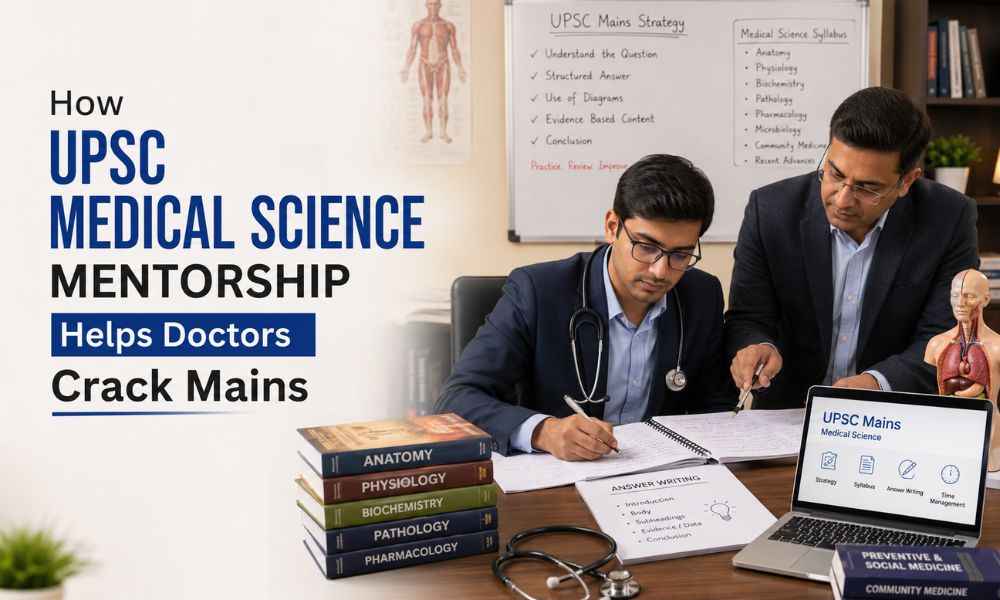
Preparing for the UPSC Civil Services Examination is challenging for any aspirant. But for doctors, the journey often comes with an extra layer of difficulty. Medical students and professionals already have a demanding academic background, busy schedules, and years of rigorous study behind them. Adding UPSC preparation on top of that can feel overwhelming.
Many doctors choose Medical Science as their optional subject because it matches their academic background. On paper, this seems like an advantage. But in reality, having medical knowledge and scoring well in UPSC Medical Science are two different things.
This is where mentorship becomes important.
UPSC Medical Science mentorship can help doctors bridge the gap between knowledge and exam performance, especially in the Mains stage where answer writing, strategy, and presentation matter the most.
Why Doctors Need a Different UPSC Strategy
A doctor preparing for UPSC is not starting from zero. They already understand anatomy, physiology, pathology, pharmacology, and clinical subjects. The problem is not lack of knowledge. The problem is direction.
Most doctors struggle with questions like:
- How much depth is enough?
- Which topics are important?
- How should answers be written?
- How to balance GS and optional together?
- How to revise such a huge syllabus?
Without proper guidance, many aspirants either over-study or study the wrong way.
Medical mentorship solves this problem by creating clarity.
Understanding the Difference Between MBBS Preparation and UPSC Preparation
One of the biggest mistakes medical aspirants make is preparing for UPSC the same way they prepared for medical exams.
Medical exams focus on:
- Detailed theory
- Clinical knowledge
- Memorization
- Practical application
UPSC, however, looks for:
- Structured answers
- Conceptual clarity
- Relevant content
- Time management
- Analytical presentation
A mentor helps aspirants understand this shift.
Instead of writing everything they know, students learn how to write exactly what is needed.
That difference can change marks significantly.
Mentorship Helps in Prioritizing the Syllabus
Medical Science Optional is vast. It covers both pre-clinical and clinical subjects.
Without a strategy, students often spend too much time on low-yield topics.
A mentor can identify:
- High-weightage topics
- Frequently repeated areas
- Important diagrams
- PYQ trends
- Topics needing deeper focus
This saves time and improves efficiency.
Rather than trying to cover everything equally, aspirants learn to focus smartly.
Previous Year Question Analysis Becomes Easier
Previous year questions are one of the strongest tools for preparation. But simply reading them is not enough.
A mentor helps break them down topic-wise and explains:
- Which themes repeat often
- How question framing changes
- What kind of answers UPSC expects
- Which topics have become more important over time
This builds pattern recognition.
Once aspirants start understanding the pattern, preparation becomes much more focused.
Answer Writing Improves Faster
This is probably the biggest advantage of mentorship.
Many doctors know the subject but lose marks because of poor answer presentation.
Common mistakes include:
- Writing too much
- Missing structure
- Not using headings
- Lack of diagrams
- Poor time management
With mentorship, answer writing becomes systematic.
Students learn:
- How to structure introductions
- When to use flowcharts
- How to make answers concise
- Where diagrams can improve marks
- How to conclude effectively
Regular feedback is what improves quality.
Personalized Feedback Makes a Big Difference
Every aspirant has different strengths and weaknesses.
Some may be strong in clinical subjects but weak in pre-clinical areas. Some may have good knowledge but poor writing speed.
Generic coaching cannot always address this.
Mentorship gives personalized support.
A mentor can point out:
- Weak areas
- Repeated mistakes
- Content gaps
- Time management issues
- Revision problems
This kind of feedback often saves months of trial and error.
Motivation and Consistency Matter
UPSC preparation is a long journey. Doctors especially face burnout because many are balancing hospital duties, internships, or postgraduate responsibilities.
It is easy to lose consistency.
Mentorship creates accountability.
When someone is tracking your progress, discussing your tests, and guiding your preparation, it becomes easier to stay disciplined.
Consistency often matters more than intensity.
Helps in Balancing GS and Optional
Many medical aspirants become too focused on optional because it feels familiar.
But UPSC requires equal attention to General Studies.
A mentor helps create balance.
This ensures:
- Optional does not consume all your time
- GS preparation stays on track
- Revision cycles remain practical
- Test schedules stay manageable
This balanced approach is essential for cracking Mains.
Learning from Someone Who Has Been Through It
This is one of the most underrated benefits of mentorship.
Learning from someone who has personally gone through the UPSC process gives practical insights that books cannot provide.
For example, at UPSCRX, Dr. Vishakha Sharma has completed MD Pediatrics from AIIMS and appeared for UPSC Interview 2025 after clearing Mains with a strong score. Having faced the challenges of Medical Science Optional herself, she understands where most medical aspirants struggle and how to approach the subject effectively.
This practical understanding often makes mentorship more relatable and realistic.
Final Thoughts
Medical Science Optional can be a highly scoring subject for doctors, but only when prepared with the right strategy.
Knowledge alone is not enough.
Success in UPSC Mains depends on:
- Smart preparation
- Answer writing
- Topic prioritization
- Consistent revision
- Personalized guidance
That is exactly where mentorship makes a difference.
For doctors aiming to crack UPSC, good mentorship can simplify the journey, reduce mistakes, and improve confidence. In a competitive exam where even a few marks can change the final result, the right guidance can make all the difference.
Don’t miss: Medical Science Mains Test Series vs Self-Practice: Which Works Better?